Last updated: August 2026 • Reviewed by the YardFit Pools team
You can install an above ground pool on a sloped yard — but only if you choose the right pool and deal with the slope first. The maximum safe slope for most above ground pools is 2 inches across the entire base. Beyond that, the frame stresses unevenly and the liner pulls toward the low side, which causes premature failure. The pools below are ranked partly by how much leveling work they demand and how forgiving they are of imperfect ground prep.
| ⚠️ The slope rule every buyer needs to know No above ground pool is designed to sit on unleveled ground. What varies is how much prep work each pool demands before install. Rule of thumb: if your yard slopes more than 2 inches across the pool’s footprint, you must level the ground before installation — no exceptions. Skipping this step is the single biggest cause of above ground pool frame failure and liner blowouts. See our step-by-step leveling guide for how to measure your slope and the cheapest ways to fix it. |
How Much Slope Is Too Much?
Measure the slope across the widest point of where your pool will sit. Use a long level or a line level and measuring tape:
- 0–1 inch of slope across the footprint: acceptable for most pools with minor ground prep.
- 1–2 inches of slope: manageable with sand leveling or sod removal. Still requires real prep work.
- 2–3 inches of slope: requires excavation or significant fill work. Smaller pools are easier to manage at this level.
- 3+ inches of slope: hire a landscaper or consider a different location. No above ground pool installs safely here without major earthwork.
| 💡 Tip: smaller pools are easier to level on a slope A 12 ft pool on a 3-inch slope needs far less leveling work than an 18 ft pool on the same slope. If your yard is significantly sloped, starting with a smaller pool and doing the leveling properly beats trying to force-fit a large pool onto bad ground. |
Quick Picks: Best Above Ground Pools for Sloped Yards
| Pool | Max Slope Tolerance* | Setup Difficulty | Liner Durability | Best For | Our Rating |
|---|---|---|---|---|---|
| Bestway Power Steel (12–15 ft) | 2 in / 1–2 in with sand prep | 3/5 | 3/5 | Mild slope, first install | ★★★★☆ 3.9/5 |
| Intex Prism Frame (10–12 ft) | 2 in / 1 in ideal | 2/5 | 3/5 | Mild slope, small yard | ★★★★☆ 3.8/5 |
| Intex Ultra XTR (18–22 ft) | 1 in / flat base strongly recommended | 3/5 | 4/5 | Flat-ish yards, long-term use | ★★★★☆ 4.1/5 |
| Doughboy Pioneer (12–18 ft) | Professional prep required | 4/5 | 5/5 | Permanent install, serious leveling done properly | ★★★★★ 4.5/5 |
| Summer Waves Elite (10–12 ft) | 2 in / 1 in ideal | 2/5 | 3/5 | Small slope, compact yard | ★★★★☆ 3.7/5 |
*Max slope tolerance = total elevation change across the pool’s widest point after any sand or fill leveling is complete. All figures assume flat-base installation rules still apply — leveling is always required.
Best for Mild Slopes: Bestway Power Steel (12–15 ft)
For yards with 1–2 inches of slope across the pool footprint, the 12 or 15 ft Bestway Power Steel is the strongest starting point. Its smaller footprint means less total leveling work compared to larger pools, and the TriTech liner handles the minor stress variations that come with imperfectly level installs better than thinner single-layer competitors.
The key: go with the 12 ft size if your slope is toward the 2-inch end. The smaller the pool, the less leveling work required and the lower the risk of frame stress from residual unevenness.
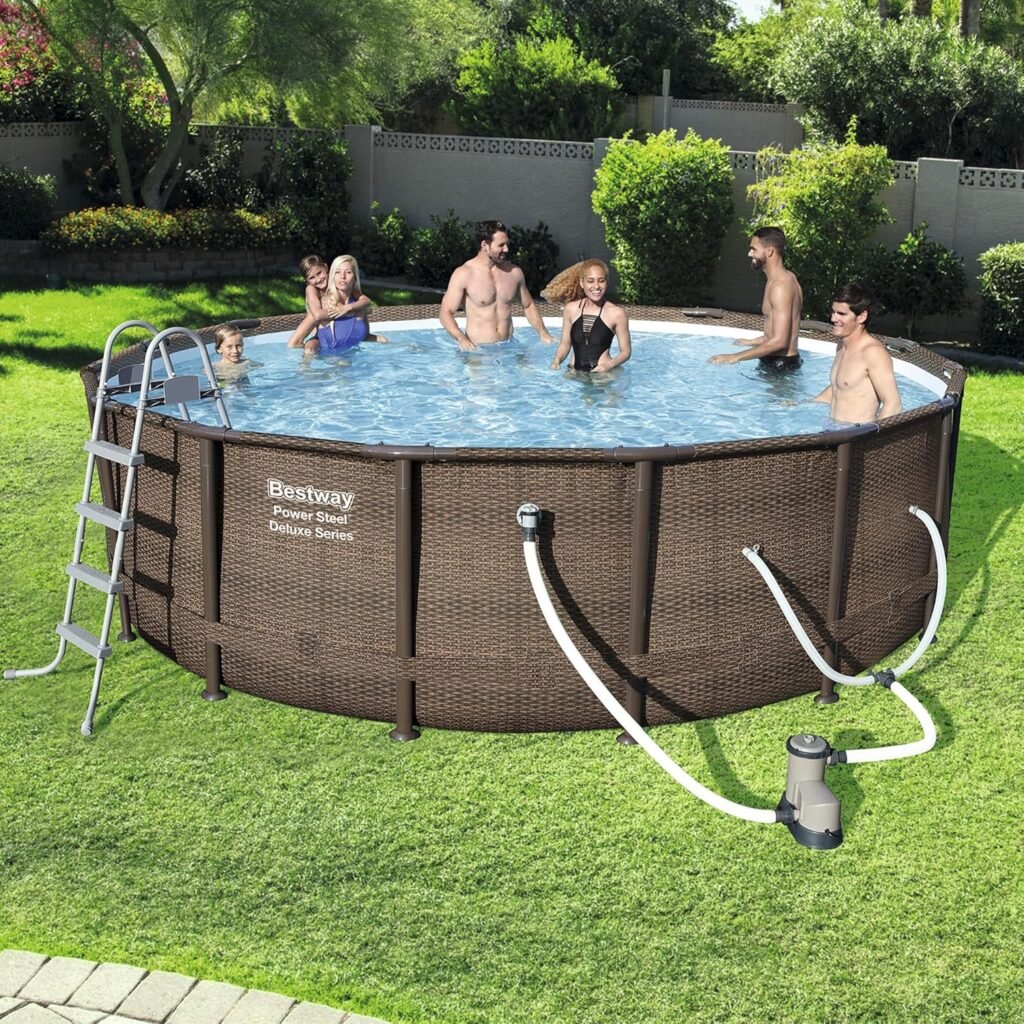
| Bestway Power Steel (12–15 ft) — YardFit Scores Setup-Difficulty Score: 3/5 (increases to 4/5 if significant sand leveling is required) Liner-Durability Score: 3/5 (TriTech three-layer liner handles minor stress variations) Max Slope Tolerance: 2 inches across footprint after leveling prep Yard-Fit Tag: Mild slopes, small-to-mid yards, first-time above ground pool install ➜ Read our full Bestway Power Steel review ➜ Check the latest prices on Amazon |
Who it’s for: Buyers with a yard that slopes 1–2 inches across the pool area, who are willing to do sand leveling before install.
Who should skip it: Anyone with more than 2 inches of slope — the ground prep required moves beyond DIY territory.
Best for Small Sloped Yards: Intex Prism Frame (10–12 ft)
The Intex Prism Frame’s smaller footprint makes it the most practical choice for sloped yards with limited flat space. At 10–12 ft diameter, the total area that needs leveling is significantly smaller than 15+ ft pools. Its 2/5 Setup-Difficulty Score reflects easy assembly once the ground is prepped — the leveling itself is the hard part, not the pool.
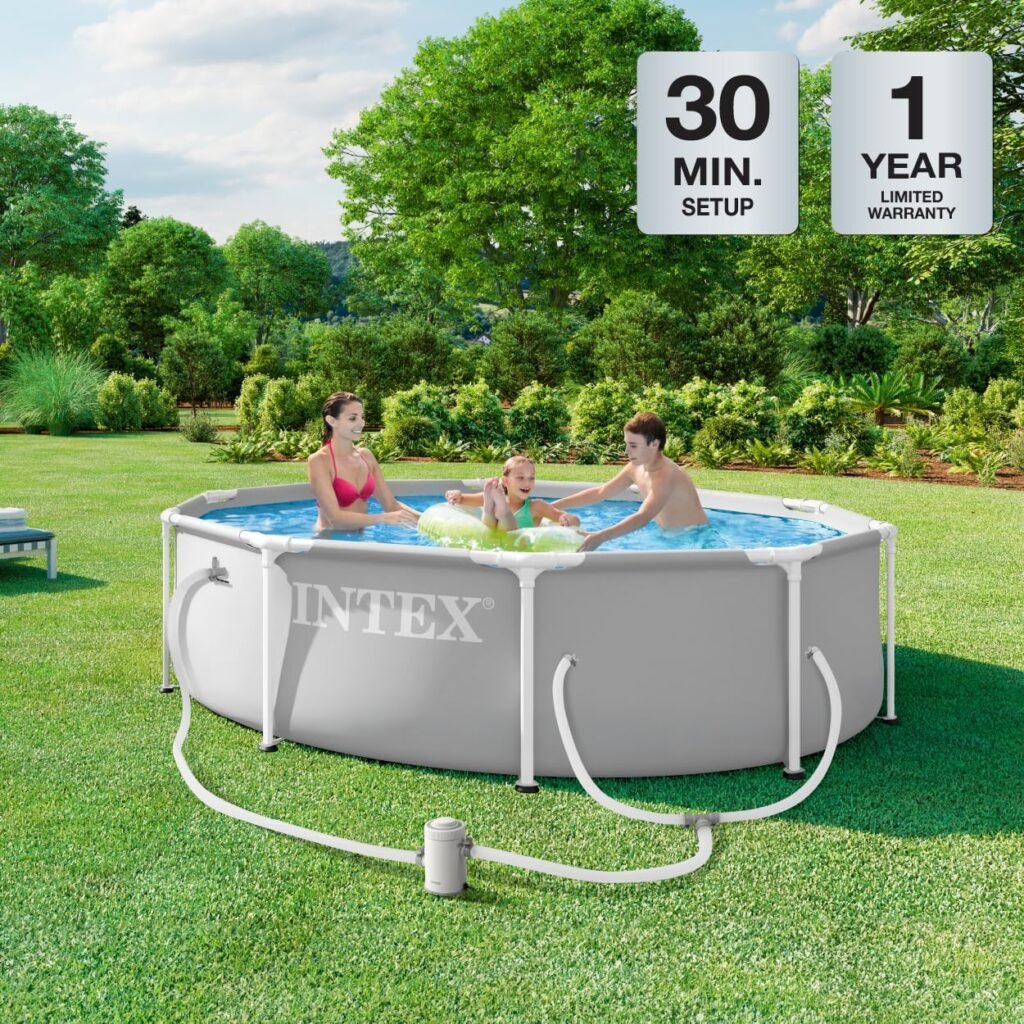
| Intex Prism Frame (10–12 ft) — YardFit Scores Setup-Difficulty Score: 2/5 (pool assembly is easy; ground prep is the real effort) Liner-Durability Score: 3/5 (reinforced sidewalls, handles minor ground irregularities) Max Slope Tolerance: 2 inches across footprint after leveling Yard-Fit Tag: Small sloped yards, urban backyards, first-time pool owners ➜ Read our full Intex Prism Frame Premium review ➜ Check the latest prices on Amazon |
Who it’s for: Small sloped yards where a larger pool simply won’t fit once you find the flattest available area.
Who should skip it: Buyers who need a pool large enough for adults to swim in — the 10–12 ft is best for younger children.
Best for Near-Flat Yards: Intex Ultra XTR (18–22 ft)
If your slope is minor — under 1 inch across the footprint — and you want a large, durable pool, the Intex Ultra XTR is the right call. Its 4/5 Liner-Durability Score gives it more tolerance for the minor stresses of near-flat (but not perfectly flat) installs. That said, this is not a pool to put on an unleveled base. The larger the pool, the more a small slope amplifies into frame stress. A 1-inch slope on a 22 ft pool is not the same as a 1-inch slope on a 12 ft pool.
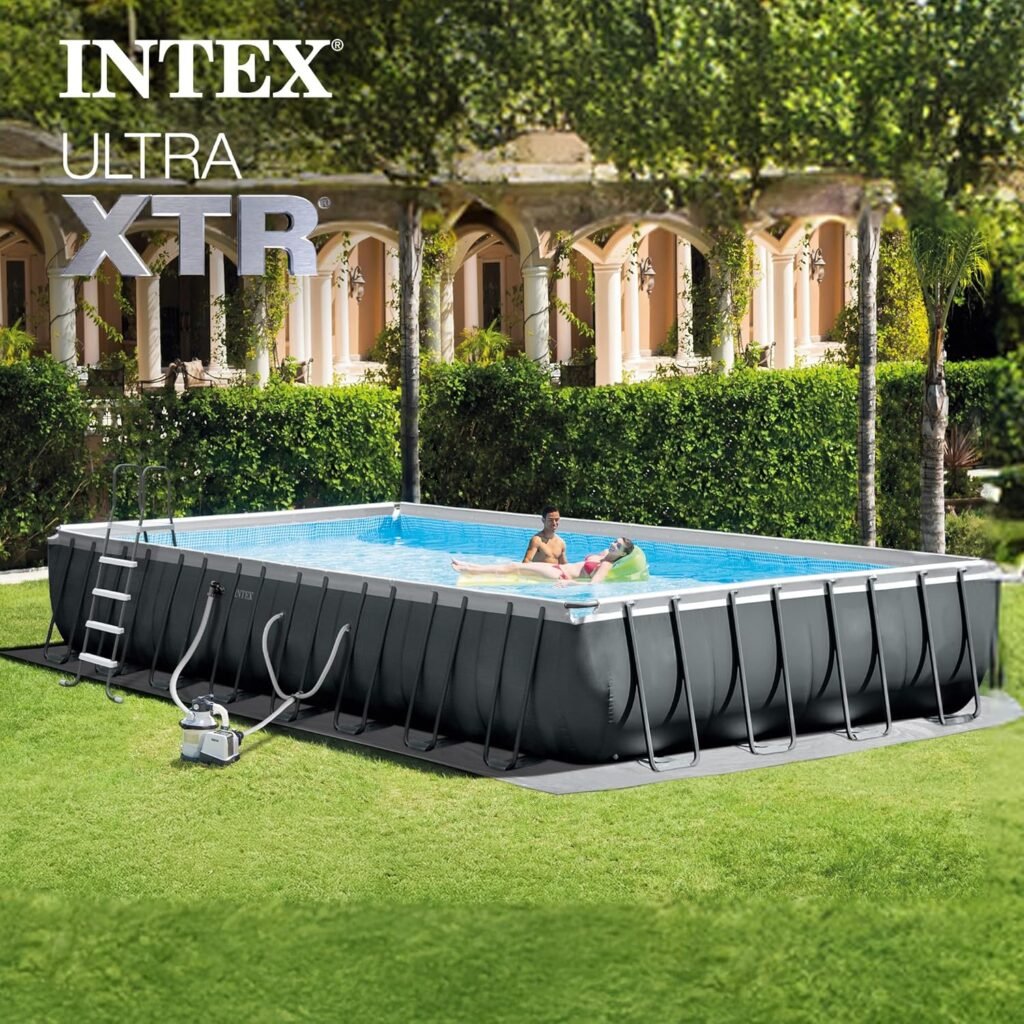
| Intex Ultra XTR (18–22 ft) — YardFit Scores Setup-Difficulty Score: 3/5 (rises significantly if substantial ground prep is needed) Liner-Durability Score: 4/5 (three-ply liner handles minor stress variations better than competitors) Max Slope Tolerance: 1 inch across footprint — flat base strongly recommended Yard-Fit Tag: Near-flat yards, standard to large backyards ➜ Read our full Intex Ultra XTR review ➜ Check the latest prices on Amazon |
Who it’s for: Buyers with a near-flat yard who want a large, durable pool that will last multiple seasons.
Who should skip it: Anyone with a genuinely sloped yard — the Bestway Power Steel in a smaller size is safer.
Best for Permanent Installs on Sloped Yards: Doughboy Pioneer
If you’re serious about installing an above ground pool on a sloped yard and want it to last a decade, the Doughboy Pioneer is the only pick — but only if you’re willing to do the job properly. It requires professional-grade ground prep: excavation to create a flat base, not sand leveling. The payoff is a resin frame that won’t rust, a 5/5 Liner-Durability Score, and a pool that can realistically last 15–20 years with liner replacements.
| Doughboy Pioneer — YardFit Scores Setup-Difficulty Score: 4/5 (professional install recommended; ground excavation usually required on slopes) Liner-Durability Score: 5/5 (resin frame, no rust, thick replaceable liner) Max Slope Tolerance: Any slope — but excavation to flat is required, not sand leveling Yard-Fit Tag: Sloped or flat yards where a permanent install is planned ➜ Read our full Doughboy Pioneer review |
Who it’s for: Homeowners with a sloped yard who want a permanent pool and are prepared to invest in proper ground preparation.
Who should skip it: Renters, anyone unwilling to excavate, or buyers on a tight timeline — proper Doughboy prep takes days, not hours.
How to Level Ground for an Above Ground Pool: The Short Version
Full step-by-step instructions are in our dedicated pool leveling guide. Here’s the quick overview:
- Measure your slope using a long level (6 ft minimum) or a line level strung across stakes. Note the total elevation change across the pool’s diameter.
- Mark the pool footprint with spray paint or stakes so you know the exact area to work with.
- Remove all grass and vegetation inside the footprint. Grass compresses unevenly and creates soft spots under the liner.
- Cut down the high side — always cut down, never build up with fill. Fill soil compresses and shifts over time. Excavate from the high side to the level of the low side.
- Add 1–2 inches of play sand (not builder’s sand) as the final leveling layer and rake it flat. Check with a level again before installing.
- Lay a ground cloth or pool pad before the liner. This protects the liner from rocks, roots, and abrasion.
| Leveling Method | Best For | DIY? | Approx. Cost | Time Required |
|---|---|---|---|---|
| Sand leveling (1–2 in slope) | Minor slopes, smaller pools | Yes | $20–60 (sand + rake) | 2–4 hours |
| Sod removal + sand (1–2 in) | Standard yards with grass | Yes | $30–100 | 3–5 hours |
| Excavation (2–3 in slope) | Moderate slopes | Possible (hard work) | $0 DIY or $200–600 hired | Half to full day |
| Professional grading (3+ in) | Significant slopes | No — hire out | $400–1,500+ | 1–2 days |
Frequently Asked Questions
Can you put an above ground pool on a slope?
Yes, but the ground must be leveled first — no above ground pool is designed to sit on unleveled ground. The slope itself isn’t the problem; installing without leveling is. If the slope across your pool’s footprint is 2 inches or less, DIY leveling with sand and excavation is realistic. Beyond 3 inches, hire a landscaper.
How much does it cost to level a yard for an above ground pool?
DIY leveling with sand and basic tools costs $20–100 for most smaller pools on mild slopes. If you need excavation or professional grading, expect $400–1,500 depending on the size of the area and the severity of the slope. This cost should factor into your total pool budget before you buy.
What happens if you don’t level the ground for an above ground pool?
The pool frame stresses unevenly, which causes joints to loosen and eventually fail. The liner pulls toward the low side, creating pressure points at the bottom seam. In severe cases, the pool can collapse sideways mid-season. Even a 3–4 inch slope can cause failure within one season if the ground is not leveled first.
What is the easiest above ground pool to set up on uneven ground?
Smaller pools are always easier to level than larger ones — there’s simply less ground to prepare. Among the picks above, the Intex Prism Frame in 10–12 ft is the easiest to get level and the most forgiving of minor imperfections once leveled.
Should I put sand under my above ground pool on a slope?
Yes, 1–2 inches of play sand is the standard final leveling layer after excavating the high side down. Sand conforms to small irregularities and protects the liner. Do not use builder’s sand (too coarse) or skip the excavation step and try to build up the low side with extra sand — it will shift under the weight of the water.
Do I need to hire someone to level my yard for a pool?
For slopes of 2 inches or less, most homeowners can handle leveling themselves with a shovel, rake, and a bag or two of play sand. For slopes of 3 inches or more, hiring a landscaper is the smarter call — the cost of improper leveling (a failed pool frame, a blown liner) easily exceeds the cost of professional grading.